What Does the DWP's Draft Fiduciary Duty Guidance Mean for Stewardship Oversight?
In short The DWP's draft fiduciary duty guidance reinforces stewardship oversight as an ongoing trustee responsibility, encompassing clear expectations, constructive challenge and assessment of managers' stewardship activity and outcomes throughout the investment manager lifecycle. While these expectations are not new, the draft brings them together explicitly within the broader context of fiduciary duty, highlighting the importance of translating existing responsibilities into effective governance practices.
The Department for Work and Pensions (DWP) is currently consulting on guidance for pension trustees on investment and fiduciary duties. The consultation closes at 11:59pm on 27 January 2027, and while the final guidance may still change, the draft provides a useful insight into how the DWP views stewardship within the broader framework of fiduciary duty.
Importantly, the draft guidance does not introduce new fiduciary duties or change existing legal obligations. Rather, it seeks to clarify how trustees' existing duties apply in practice.
The draft addresses a wide range of issues, including financial materiality, long-term risks and investment decision-making. Among these, the stewardship sections stand out for their emphasis on trustee oversight.
Stewardship is positioned as an integral part of the investment process rather than a separate investment objective, supporting the management of risk and the creation of long-term financial value for members.
Within that context, the guidance addresses a practical question: what role should trustees play in overseeing stewardship activities carried out on their behalf?
Building on existing stewardship expectations
The draft guidance does not emerge in isolation.
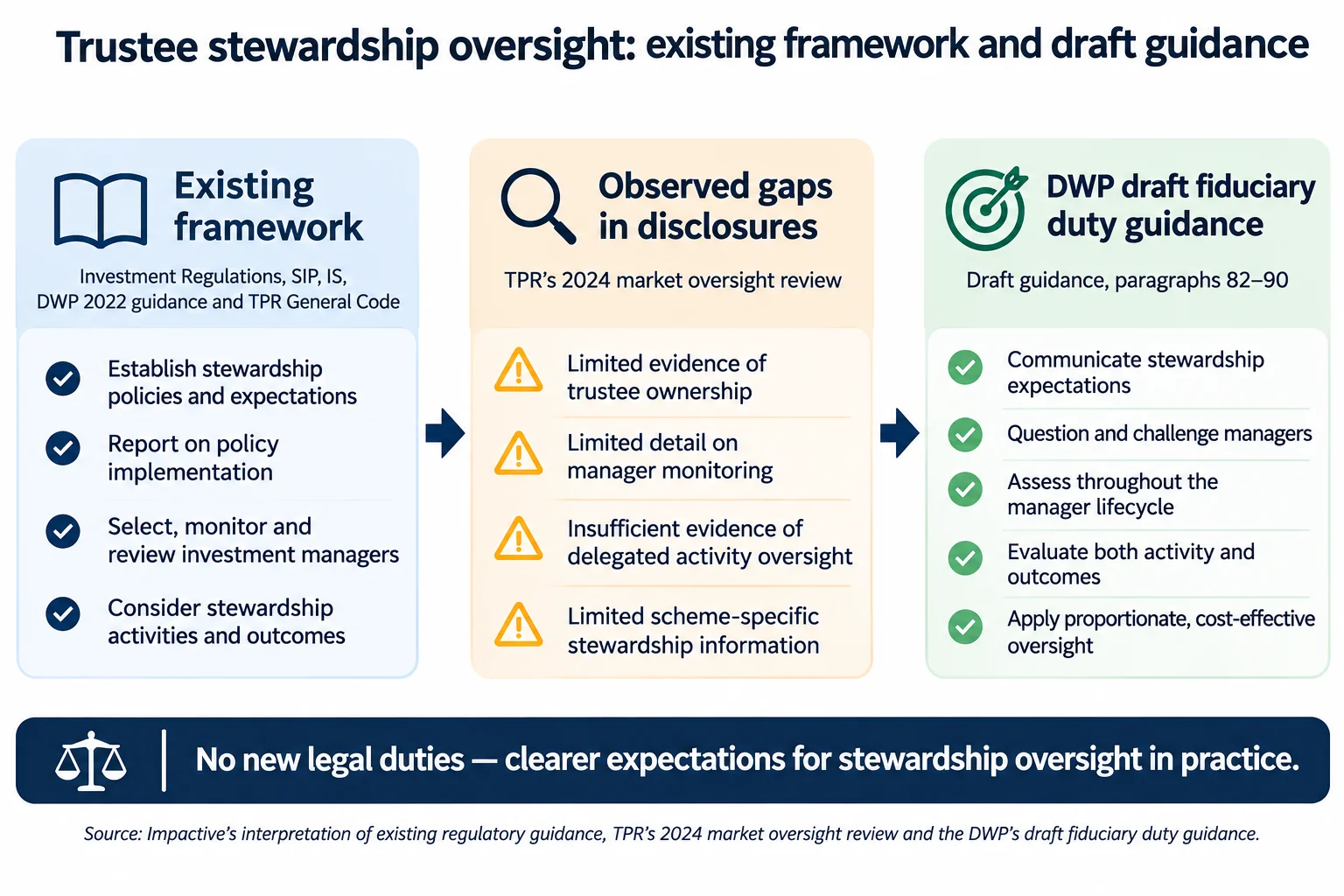
Trustees of pension schemes within scope are already required to set out their stewardship policies in their Statement of Investment Principles (SIP) and explain how relevant policies have been implemented through their Implementation Statement (IS).
However, the existing framework extends beyond policy setting and reporting.
The DWP's 2022 statutory and non-statutory guidance on stewardship reporting already encourages trustees to consider managers' stewardship activities and outcomes before appointment, communicate their stewardship preferences and monitor managers' approaches.
Similarly, The Pensions Regulator's General Code of Practice, which came into force in March 2024, sets out expectations regarding stewardship in manager selection, monitoring and review.
These existing requirements and expectations are important context for interpreting the new draft.
What makes the draft noteworthy is how explicitly it brings together stewardship expectations, manager oversight and effectiveness within the broader context of fiduciary duty.
From stewardship expectations to effective oversight
Paragraph 85, in particular, crystallises the DWP's thinking. It highlights the importance of communicating stewardship expectations, questioning and challenging investment managers, and assessing their stewardship performance:
“But trustees should expect to engage with the investment managers and to question and challenge. Pension fund trustees will wish to have processes for the proper communication of their desired approach to stewardship, and for proper oversight of the investment managers’ work on stewardship to reassure themselves of its effectiveness. Trustees should take stewardship performance of managers into account before appointment and in monitoring and at review, both in terms of activity and outcomes.”
The individual elements of this approach will be familiar to many trustees, investment consultants and asset managers.
What is particularly noteworthy is how they are brought together as part of trustees' investment governance responsibilities.
Receiving stewardship reports is one element of oversight. Trustees also need to consider what they expect stewardship to achieve, how managers are delivering against those expectations and whether their approach is effective.
The distinction is not between old and new fiduciary responsibilities, but between articulating those responsibilities and putting them into practice.
Oversight starts with clear expectations
One aspect of the draft worth highlighting is the importance it attaches to communicating trustees' desired approach to stewardship.
Effective oversight starts with clear expectations. Assessing a manager's stewardship performance becomes difficult without an understanding of how stewardship is intended to support the scheme's investment objectives and address financially material risks and opportunities.
This means considering not only a manager's stewardship capabilities but also how its priorities and approach align with those of the pension scheme.
A stewardship policy provides an important starting point. The practical question is how that policy informs conversations with managers, their appointment and subsequent assessment.
Oversight, therefore, begins well before trustees receive their first stewardship report.
Stewardship throughout the manager lifecycle
The draft envisages stewardship performance informing decisions at manager selection, throughout the investment relationship and as part of formal reviews.
This approach is already reflected in existing DWP and TPR guidance. The draft reinforces it by bringing these stages together explicitly within its discussion of fiduciary duty.
Stewardship is positioned alongside other considerations that inform the appointment, monitoring and retention of investment managers.
An annual stewardship presentation may provide a useful opportunity for discussion, but its value is greater when trustees can assess progress against previously established expectations and follow up on issues identified over time.
The implication is an ongoing approach to stewardship assessment, rather than treating it as an isolated reporting exercise.
This does not mean that every scheme needs to adopt the same monitoring framework or frequency of review. The appropriate approach will depend on the scheme's circumstances and investment arrangements.
The role of trustees in questioning and challenging managers
Much of the industry's discussion of stewardship focuses on the activities of asset managers. The draft brings the role of trustees themselves into focus.
Delegating stewardship to an investment manager does not remove the need for trustees to exercise appropriate oversight.
In practice, constructive challenge might involve exploring why certain stewardship priorities have been selected, how escalation decisions are made, how voting and engagement approaches align with the scheme's interests, or how managers assess the effectiveness of their interventions.
It may also involve following up on previous discussions, examining the evidence of progress and understanding how managers respond when stewardship objectives are not being achieved.
This is not about trustees second-guessing every decision made by their investment managers. It is about developing sufficient understanding to exercise informed oversight.
Stewardship may be delegated. Responsibility for appropriate oversight remains with trustees.
Looking at activity and outcomes
A particularly significant aspect of paragraph 85 is its explicit reference to both stewardship activity and stewardship outcomes.
Although this distinction is already reflected in the DWP's 2022 stewardship guidance, its inclusion within the draft fiduciary duty guidance reinforces its relevance to investment governance.
Activity is generally easier to observe. Engagement programmes, voting records, escalation decisions and company case studies can all help trustees understand what managers are doing.
Outcomes are harder.
How should trustees assess whether stewardship is contributing to progress on financially material issues? What evidence indicates that an engagement is moving in the right direction? How should effectiveness be assessed when change may take years to materialise and cannot necessarily be attributed to a single investor's intervention?
The distinction is important. A high volume of engagement does not necessarily demonstrate effectiveness, just as the absence of an immediate outcome does not necessarily indicate ineffective stewardship.
Paragraph 90 reinforces this point by inviting trustees to examine the purpose and effectiveness of stewardship, its connection to investment risks and opportunities, and whether additional action would be justified.
Although the draft does not prescribe a particular methodology or set of performance metrics, it provides a useful basis for moving the discussion beyond activity alone.
Proportionality matters
An important qualification is set out in paragraph 84: stewardship should be “appropriate, balanced and proportionate, and cost-effective”.
The nature and depth of oversight will consequently vary between pension schemes, reflecting factors such as their size, resources, investment structure and exposure to financially material risks.
For some schemes, effective oversight may involve detailed analysis of individual managers' stewardship performance. For others, it may involve a more focused assessment of key priorities, supported by investment consultants or other service providers.
Trustees investing through pooled funds may also face different practical considerations from those with segregated mandates, particularly regarding their ability to influence individual voting and engagement decisions.
The objective is not to maximise the amount of stewardship monitoring undertaken, but to establish an approach that enables trustees to exercise informed and effective oversight in a manner appropriate to their scheme.
Closing the gap between expectations and practice
The distinction between existing stewardship expectations and their practical implementation is particularly relevant in light of The Pensions Regulator's 2024 review of trustee compliance with environmental, social and governance duties.
Although around 99% of schemes reviewed provided publicly accessible links to the relevant disclosures, the regulator identified shortcomings in the evidence of trustee ownership, oversight of delegated activities and scheme-specific stewardship reporting.
In particular, the review highlighted instances where trustees referred to monitoring their investment managers but provided limited detail about what that monitoring involved.
These findings relate to the evidence available through the disclosures reviewed in 2024. They do not necessarily mean that effective oversight was absent, nor do they establish the current position across all pension schemes.
Nevertheless, they illustrate an important distinction: compliance with disclosure requirements does not, in itself, demonstrate effective stewardship oversight.
The draft fiduciary duty guidance can therefore be viewed in the context of an existing challenge for the industry: translating established stewardship expectations into effective, demonstrable governance practices.
The practical challenge
For many pension schemes, the challenge may not simply be a lack of information.
Asset managers already produce extensive stewardship reports, voting disclosures and engagement case studies. The industry has made significant progress in transparency and disclosure over the past decade.
The harder task is turning that information into effective oversight.
Can stewardship performance be assessed consistently? Can different managers' approaches be compared while recognising differences in investment strategies and mandates? Can progress be monitored over time? Can trustees distinguish between activity and effectiveness? And can the findings inform subsequent discussions and investment decisions?
There is also a question of continuity. How can trustees connect the expectations established at manager appointment with subsequent stewardship activity, evidence of progress, outcomes and decisions made at review?
Answering these questions requires more than collecting information. It requires a way of connecting stewardship evidence to the scheme's expectations, investment objectives and oversight decisions.
It also requires trustees to determine what evidence is sufficient to support their assessment, taking account of the limitations of stewardship data, the complexity of measuring outcomes and the resources available to the scheme.
These challenges are not new, but the draft guidance brings them into sharper focus.
An important conversation for the industry
With the consultation open until 27 January 2027, it is too early to draw firm conclusions about the final guidance or its eventual impact.
However, the draft's treatment of stewardship provides a useful indication of the DWP's thinking. The emphasis extends beyond what investment managers do to how trustees establish expectations, assess performance, challenge managers and satisfy themselves that stewardship is serving the interests of the scheme and its members.
The draft does not create new legal duties or prescribe a uniform approach to stewardship oversight. Many of its expectations are already reflected in existing legislation, guidance and regulatory expectations.
Its significance lies instead in bringing these elements together within a broader articulation of trustees' fiduciary responsibilities.
For the pensions industry, the question is not whether stewardship oversight is a new responsibility. It is how existing responsibilities can be translated into effective, proportionate and demonstrable governance practices.
The distinction between stewardship reporting and effective stewardship oversight remains fundamental.
How trustees bridge that gap may become one of the more important stewardship discussions in the years ahead.
Further reading
- DWP: Pension fund trustees guidance – draft
- DWP: Pension trustees' investment and fiduciary duties consultation
- DWP: Reporting on stewardship and other topics through the Statement of Investment Principles and the Implementation Statement – statutory and non-statutory guidance (2022)
- The Pensions Regulator: General Code of Practice – Stewardship
- The Pensions Regulator: Market oversight – Environmental, social and governance duties (2024)